Range

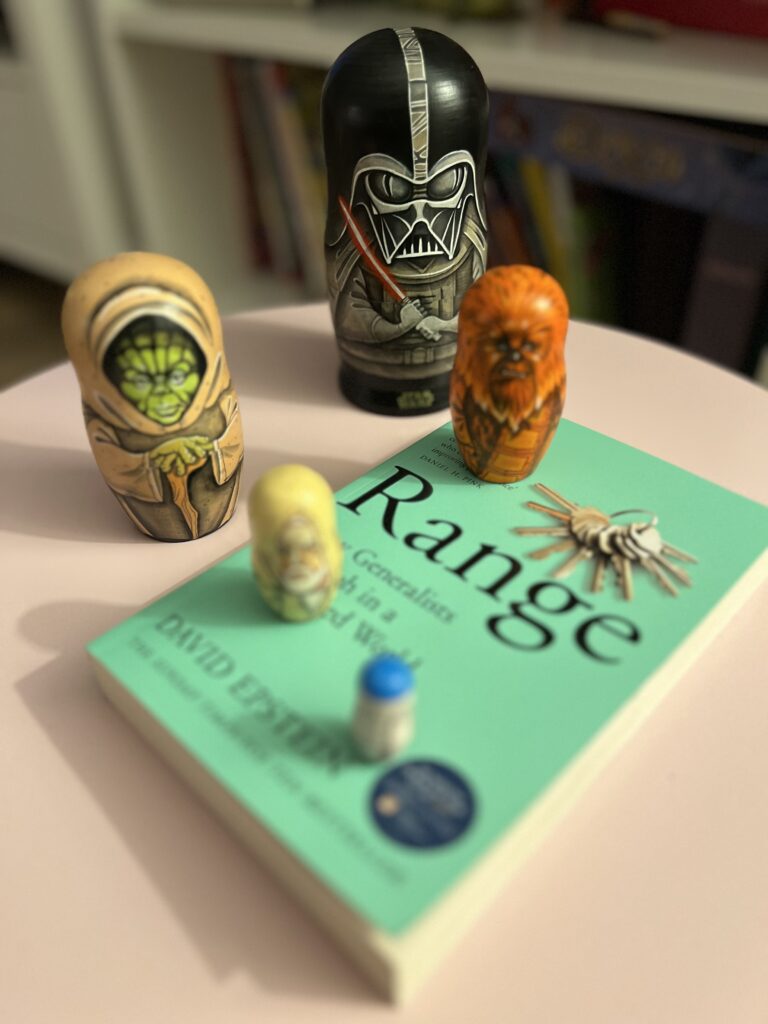
Currently reading Range by David Epstein. A timely reminder for internal auditors.

Epstein argues that deep specialization often narrows the solution space. Complex problems, the kind that live in grey areas rather than checklists, are frequently solved by people coming from outside the immediate field.
That resonates with how our profession is often assessed.

I regularly get asked: “Have you performed this specific audit before?”
Perhaps the more interesting question is: “Have you not done it before?”

Because not having audited something before can mean fewer assumptions, less attachment to legacy approaches, and more curiosity about what might be hidden one layer deeper.

Over-specialisation can start to resemble a Russian matryoshka doll: each layer familiar, each step inward smaller, tighter, and more predictable. Useful, but limiting.

Internal audit is not about repeating known routines. It’s about sense-making in complexity, connecting dots across domains, and seeing patterns others miss.

Range, not just depth, is a feature, not a bug.
Bank Asset Liability Program

I recently attended an excellent course at AIF — the Bank Asset Liability Program — led by Moorad Choudhry, and what an experience it was.

From an internal audit perspective, the course was exceptionally valuable. Moorad’s depth of knowledge in banking, risk management, and balance sheet strategy is remarkable, but what truly stood out was how he translated complex concepts into practical, real-world examples. This made it much easier to see not only how things should work, but where risks actually emerge in practice.

I especially appreciated how Moorad continuously brought in the viewpoints of different stakeholders — treasury, risk, ALCO, senior management, regulators — which is exactly the kind of holistic perspective internal auditors need to effectively assess governance, process design, and control effectiveness.

Inspired by the course, I’m now diving into his book The Principles of Banking. If I can read half as fast as Moorad can lecture, I should be in good shape.

Highly recommended for professionals in finance, treasury, and risk — and especially for fellow internal auditors looking to deepen their understanding of ALM and banking fundamentals.

📚 Summer Reading ☀️

Before diving back into audits, risks, and controls, I’m taking off for my summer break—and finally got my reading list sorted. I try to pack light, so most of my books are digital, but there’s one I couldn’t leave behind. Here’s what’s lined up on my Kindle (and in my bag):

– Mickey7 by Edward Ashton
The only physical book I’m bringing—I’m already halfway through. A witty and clever sci-fi novel with a dark sense of humor.

– Foundation by Isaac Asimov
After watching the series, it’s time to explore the original. Timeless ideas about systems, predictions, and unintended consequences—sounds oddly familiar to auditors, right?

– Bushido
Inspired by historian Sarah Payne’s videos. I’m curious to learn more about the way of the samurai and the values behind it.

– Courage is Calling by Ryan Holiday
My introduction to Stoicism. Looking forward to seeing what the hype is all about.

– The Richest Man in Babylon by George S. Clason
This one has been sitting on my Kindle for ages. Time to find out why I downloaded it in the first place.

Wishing everyone a chance to rest, recharge, and enjoy the summer.
☀️📖 What’s on your summer reading list?

Getting the Basics Right: The Foundation for AI

In the current business world, there’s a growing buzz around the use of Artificial Intelligence. While AI holds immense potential for enhancing process efficiency and effectiveness, it’s crucial to remember that successful AI implementation is built on a solid foundation of basic IT general controls.

Many organizations are eager to jump on the AI bandwagon, but it’s concerning to see that some still struggle with establishing robust IT general controls. These controls, which include system and network access controls, program change management, and data integrity controls, are the bedrock of any IT system. They help ensure the reliability, security, and integrity of data – prerequisites for any AI system.

Before we venture into the exciting realm of AI, let’s take a step back and focus on getting the basics right. Let’s invest in setting up strong IT general controls, creating a secure and reliable IT environment. Only then can we truly leverage the power of AI in internal audit, ensuring our AI systems are as effective and trustworthy as they are innovative.

Remember, in our quest for technological advancement, the basics should never be overlooked. After all, you wouldn’t build a skyscraper without first laying a strong foundation.

How can we not depict in this post an AI generated picture 🙂

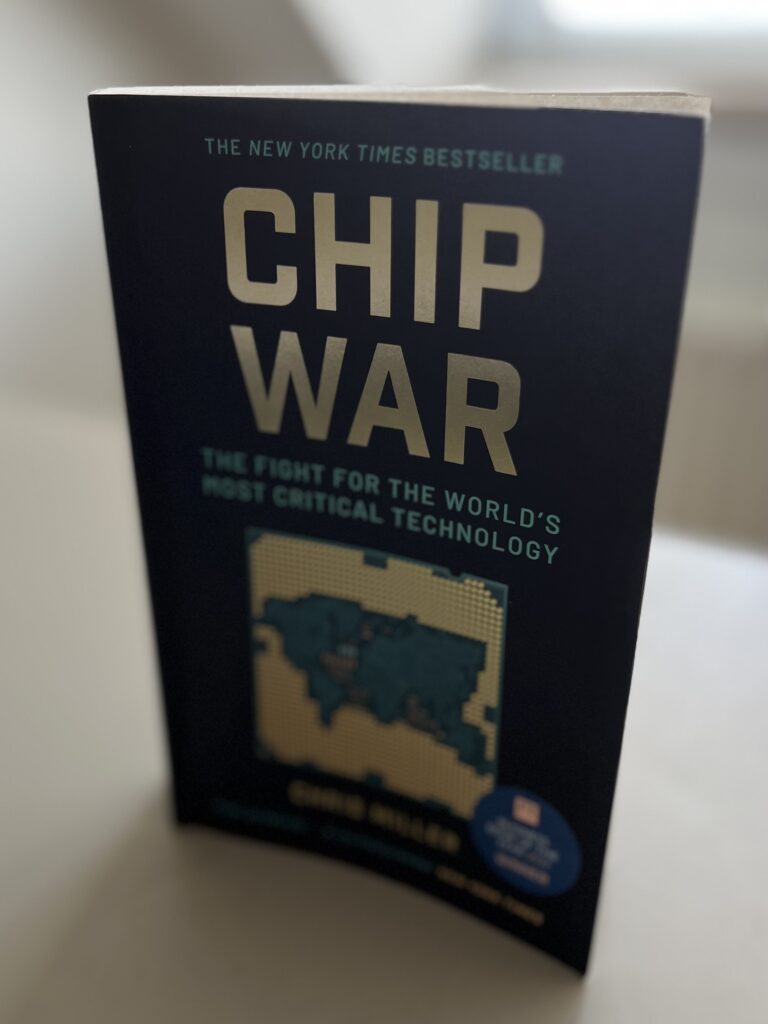
Chip War by Chris Miller

I just finished reading Chip War by Chris Miller. If you are interested in the intersection of technology and geopolitics, this is a must-read.

In his book, Chris Miller brilliantly uncovers the geopolitical, technological, and economic complexities of the global semiconductor industry.

One of the key insights from the book is how the chip supply chain is marked by critical choke points. The manufacturing of semiconductors involves a delicate global web of highly specialised processes—from raw material extraction to advanced manufacturing, design, and distribution. Certain stages, such as the production of high-end chips by companies like TSMC in Taiwan or the critical role of equipment suppliers like ASML in the Netherlands, have become strategic bottlenecks. These choke points have made the semiconductor industry vulnerable to political, economic, and technological disruptions.

Miller’s analysis not only highlights the fragility of this supply chain but also the power struggles over who controls these pivotal points, shaping the future of industries and nations.

#chipwar #chrismiller #chip #semiconductor #asml #tsmc

Amplifying the Rhythm of Business: The Role of Internal Audit

As a freelance internal auditor, I often find myself contemplating the essence of our role and how we can truly add value to the organizations we serve. It’s not always easy to articulate this, especially when the business side may not fully grasp the function of internal audit.

The Institute of Internal Auditors (IIA) defines internal auditing as “an independent, objective assurance and advisory service designed to add value and improve an organization’s operations.” While this definition is accurate, it doesn’t always resonate with everyone. Believe me, I’ve tried explaining this to my mom and my 7-year-old daughter, and they’re still trying to figure out what I do!

Recently, I came across a video of Viktor Wooten, arguably the world’s best bass player, explaining the role of a bass player in a band’s rhythm section. He said, “I am going to reshape his groove and make it sound better”, “My job is not just to play with him, my job is to make him sound BETTER.”

This struck a chord with me. As internal auditors, our role is akin to that of a bass player in a band. We’re not just there to keep time; we’re there to enhance the rhythm, to make the organization ‘sound’ better. We audit, we advise, and we groove with the organization, helping it to perform its best tune!

What are your thoughts on this analogy? I’d love to hear your insights.

Factfulness

It is so nice to read a book with a lot of good news. Especially now. The news these days is filled with bad news about the environment, politics, geopolitics, war and conflict, etc. So therefore, it was really nice to read about the world and humanity and how it improved over the years and that the state of the world is actually better than we think. I loved all the data that is used in this book, and it shows again to really check certain claims or news with real and objective data. Rosling keeps comparing the scores of all the questions about the state of the world given by all kinds of different people (scientist, journalist, government, etc.) to his control group, namely chimpanzees. The chimps’ scores are random, but most of the so-called experts usually score worse than that. It shows that we have such a strong bias and don’t know or believe the data.

Being an auditor it is sort of my job to look for things that are going wrong, and therefore it is so important to keep your mind open for things that are going well. I think we sometimes forget to mention the good things in an audit report. This book showed me that we need to be more open minded and share more of the things that are going well and celebrate them!

Lifelong rocking

At the beginning of every year, I always need to come up with a plan how to get my 40 hours of permanent education for my different audit certifications. Since I have been doing this for some time, I sometimes wonder what I can still learn and what else is out there. I am a big believer of lifelong learning, but feel that this is not always as easy as it sounds. 

Recently I watched an interview by Rick Beato with Paul Gilbert. Paul Gilbert is guitar legend and I think most people who were there during the nineties will know him from the band Mr. Big and hits such as “To be with you”. 

My biggest take away from the interview is first of all you will never stop learning. Paul Gilbert didn’t let the status of guitar hero stop him from learning and practicing every day. His curiosity into all things musical really gave me the idea that indeed you can still develop into your field of expertise even after being in that field for many years. And don’t think too big, chop it into small pieces that are easy to master and build from there. Start with an awesome lick and before you know it, you know the whole song. 

Secondly, Paul doesn’t really take himself too seriously. I love his sense of humor and how he makes everything sound and look so easy. And he is not afraid to look outside his comfort zone.

So, for me plenty of inspiration to keep learning! Not just as an internal auditor, but of course also as a guitarist. 

BTW, Mr. Big is coming to de Melkweg on 30th of July this year! Get some tickets before they are gone. See you there!

Reflecting on 2023

I always like to reflect on the previous year on New Year’s Day. Usually, I have a whole list of books that I read, but last year was a bit different. At the beginning of 2023, my wife, Anastasia, referred a podcast to me by Andrew Huberman on the effects of alcohol. This podcast had such a great effect on me that I decided to stop drinking alcohol. And this led to more fantastic podcast on for instance improving your sleep. Needless to say, a lot of things changed for me for the better during 2023. 

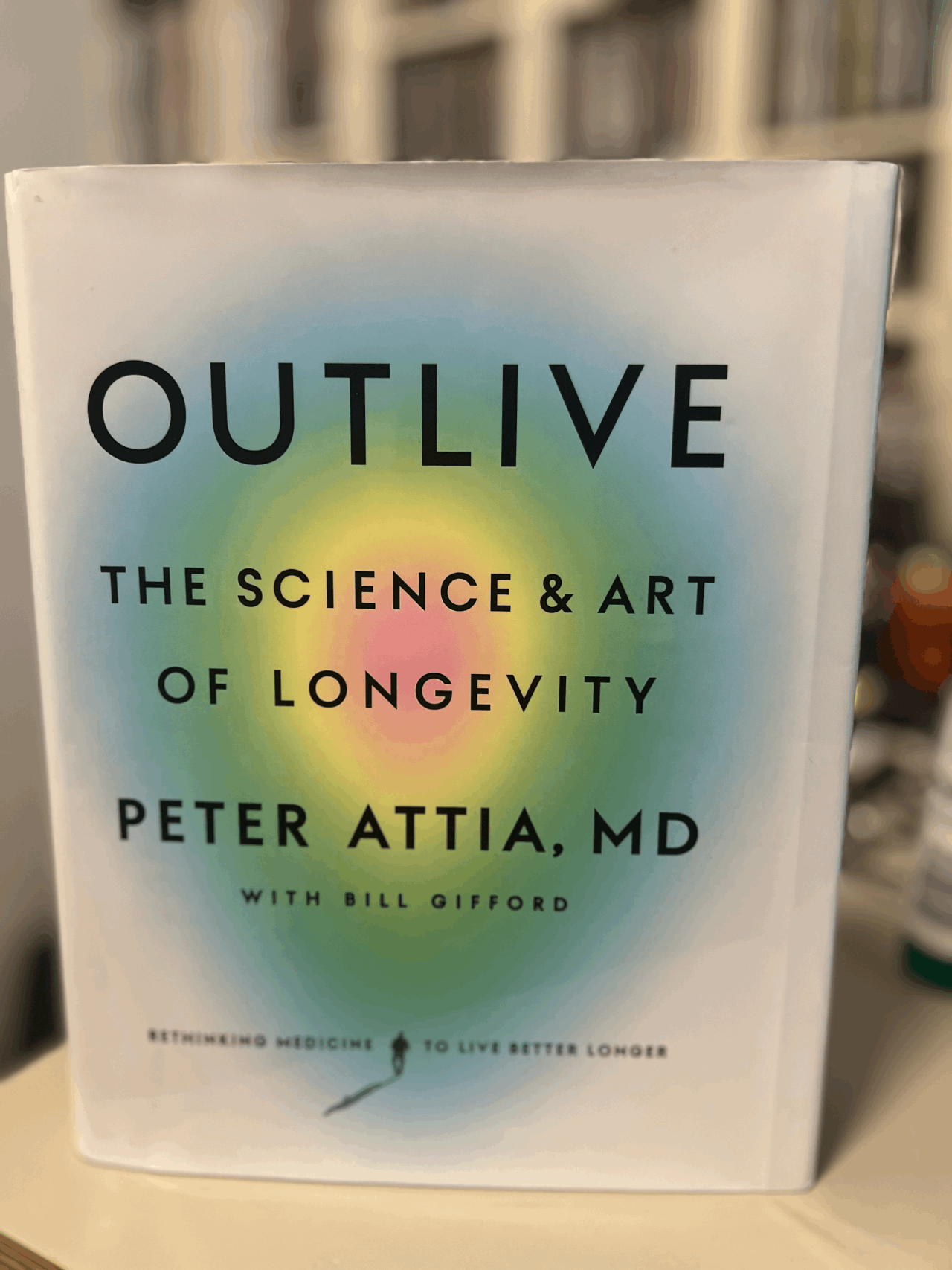
In my new search to improve my health even further (we are making our own kombucha nowadays and I take cold showers/icebaths :-)), I stumbled upon the new book by Peter Attia called Outlive. This book is almost a bible on how to improve your health, how it all happens and very specific instructions on how to do it. Especially that last part I always miss in most self-help books. To get through all of this took me some time, so a lot of the books that I wanted to read in 2023 are being rescheduled. Also, Peter Attia has a great podcast that will give you insights in improving your health and how to do it. Mind you, this stuff is pretty addictive!

PS Of course I will have another list for books to read in 2024 soon. 

Books to read in 2023

2023 has started and new plans have been made, new projects defined. And of course a new bunch of books I want to read! 

What are you reading or planning on reading? Any recommendations? 

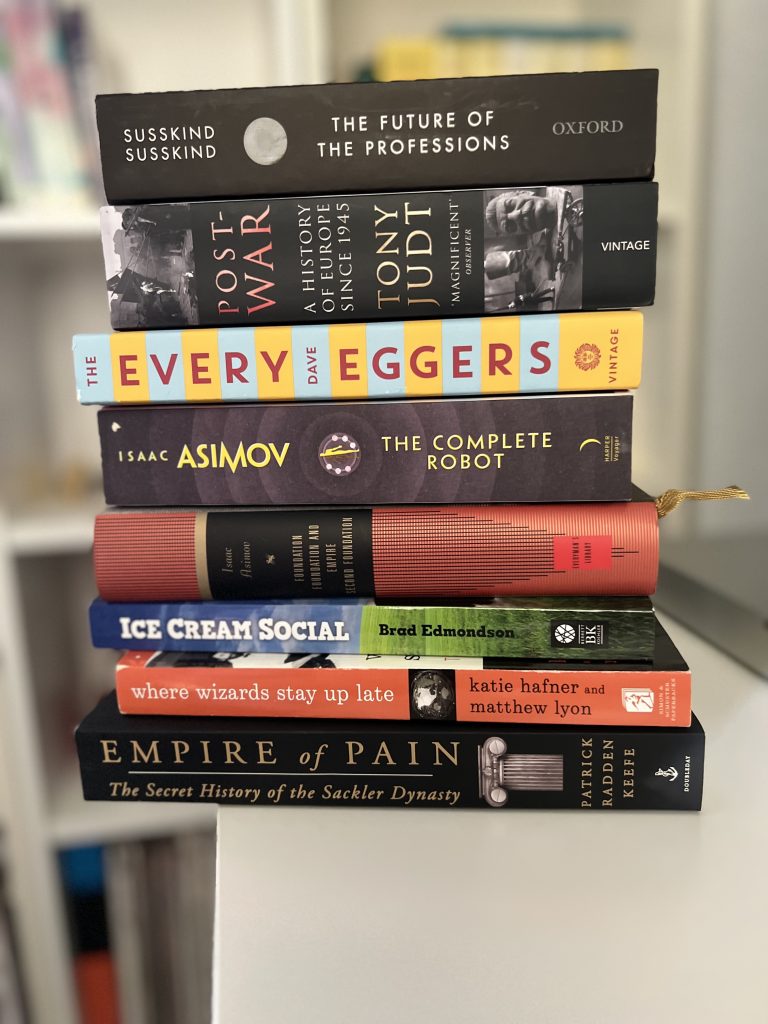
The Future of Professions by Susskind

This book was referred to me during a lecture during the ISACA Risk Event I attended recently. Really curious if I will have a job in the future :-).

Post-War: A History of Europe since 1945 by Tony Judt

All recent events made me more curious about how some things came about. This book seemed like a good starting point to understand better how Europe got defined after WWII. 

Every by Dave Eggers

I really enjoyed the Circle by Dave Eggers. This one seemed interesting as well. Since I am trying to read more fiction, this seemed like a good choice. 

The Complete Robot Series by Asimov

I love science fiction, and I read some parts of the Robot series. The stories are quite old, but still so relevant and interesting. How to deal with robots (also think AI), and what are the consequence for humans or mankind. So now I got them all! I can’t wait to read them. 

The Foundation by Asimov

I really liked The Foundations series on Apple TV+. Not sure when the second season is coming, I hope to get a head start with reading the books of the series. 

Ice Cream Social by Brad Edmondson

I hope to learn more from this book on ESG and how to run a company with a more social and inclusive vision. I really liked “let my people go surfing” by Chouinard, and hope this adds to that. 

Where Wizards Stay Up Late by Hafner and Lyon

Who doesn’t like the internet? Let’s see how it all started. 

Empire of Pain by Patrick Radden Keefe

I started working in the industry thanks to the Sarbanes Oxley legislation, since then I am interested in the failures of companies like Enron and World.com. Or how things could fall apart with Lehman Brothers and Bear Stearns. Or huge fraud like with Bearings. Plenty of examples… And now this one on my book shelve, the story of the Sackler family.